Ellipse-tracing system
Here's a curious fact: the following code draws an ellipse:
x = 0; y = 1; t = 0.25 # Or any other x, y, -2 < t < 2
for i in range(100):
  x -= y * t
  y += x * t
Explaining why this is exactly an ellipse is not intuitive, but with the help of people over at MathOverflow, it can be shown that it fits nicely into the general equation of an ellipse.
(Or, you could also use eigenvectors and eigenvalues to prove quasiperiodicity, but why complicate the math? 😂)
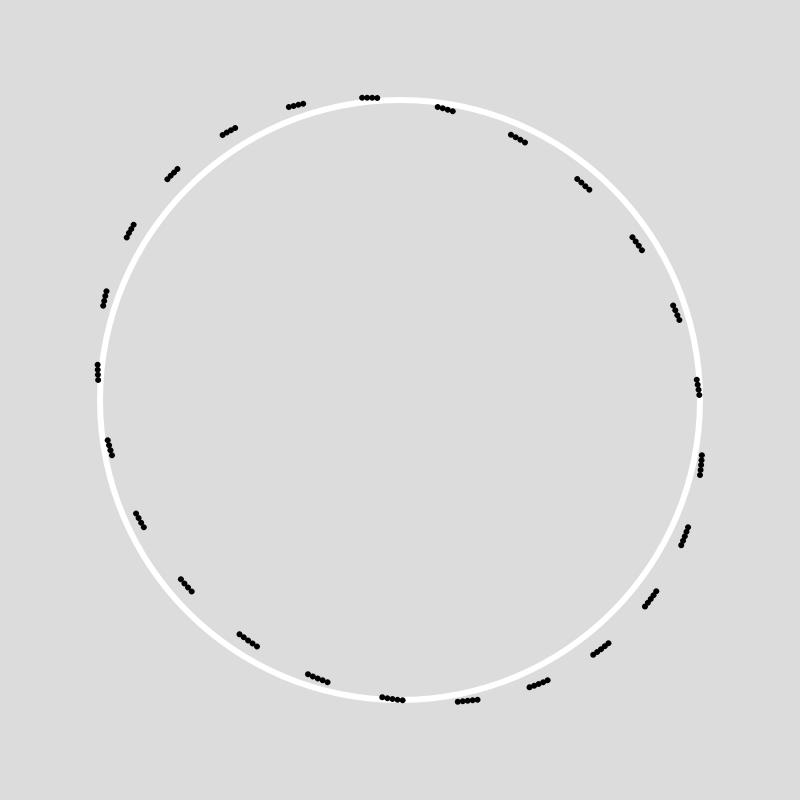
function setup() {
  createCanvas(400, 400);
  background(220);
  noFill()
  strokeWeight(2)
  stroke(255)
  circle(200, 200, 300)
  stroke(0)
}

let x = 1
let y = 0
let t = 0.25

function draw() {
  // // Traces a perfect circle: (rotation)
  // [x, y] = [
  //   x * sqrt(1 - t * t) + y * -t,
  //   y * sqrt(1 - t * t) + x * t
  // ];

  // Traces an ellipse... but why?
  [x, y] = [
    x + y * -t,
    y + x * t - y * t * t
  ];

  // // Identical:
  // x -= y * t
  // y += x * t

  point(x * 150 + 200, y * 150 + 200)
}
(Originally seen at https://editor.p5js.org/bojidar-bg/sketches/r4dHBzVPU)
Browse more articles?
← Musical Critter Experiments tagged p5 (71/85) Reflection fractal →
← Musical Critter Experiments on this site (71/85) Reflection fractal →