A note on note-taking
Taking notes is fun!
It can supposedly make you look sophisticated too, but unless you are taking notes in a tiny A6-or-smaller notebook, while walking, in a park, I wouldn't call it that "sophisticated" :upside_down: It's just normal to take notes!
It can also be pretty rewarding—granting a way to comprehend better, faster, and remember more, for longer, compared to cramming things into one's mind without notes.
Though, on that note (😁)... I'm afraid note-taking doesn't work the same for everyone—some brains prefer other ways of soaking in information, and I have no idea what works for you.
That said, here are a few tricks I've picked up in my note-taking over the years:
Always. Write. Dates.
(Or the AWD for short)
The thing I most regret about my early note-taking is that I never wrote down the date at which the note, or sketch, or scribble was made. Instead, all I had was a title which said something like "Math". In theory, I can guess the date if I were to look at all the textbooks I've studied over the years, and then correlate those with the exercises and answers worked out on the page, but that sounds extremely painful.
It's much simpler to have a written-down date in a corner of the page. Then, you can confidently say things like "oh, I've been thinking about this since 2 years ago", and also you can correlate notes and ideas with other events that happened in your life, such as "my revolutionary networking stack was inspired by procrastinating packing my luggage for a long trip". Wouldn't that be cool! 😂
Even better, writing down the date helps keep track of time. In the modern world of gadgets and inventions for timekeeping that update automatically, it's easy to forget what day it is. Not so easy if you have to write down the date every day.
Naturally, I write all my dates in ISO format; that is "YYYY-MM-DD", e.g. "2026-06-13". I don't get any of the usual benefits of that format, like "sorting" or "compatibility with other systems", because it is just a note, but I like how it keeps the "most significant digit first" structure of Arabic numerals.
Make up your own formats
(The MUYOF of an interrupted cat)
Your notes are for you, and you alone. They don't need to be pretty or have good handwriting, they don't need to be understandable for others, they don't need to be comprehensive or even exist.
That means you can use whatever notation you want to express things.
For example, here are few notations I use:
Problem answers
In my school and college years, I had a bunch of exercises to do. As we did not always buy the student notebooks (waste of paper, especially when I moved to electronic textbooks), I needed a way to record the answers of exercises. So, for such an important topic, where being able to show my exact answer is crucial... I came up with the most cryptic notation I've ever used. 😂
It goes like this:
The left margin holds the number of the problem set. Then, we have: the sub-problem number, a vertical bar, the answer, another vertical bar, and then the next sub-problem number.
It is especially fun with math problems that don't require showing your work:

Tasks
My task-tracking notation is vaguely inspired by bullet journals. Which in turn says that you should come up with your own notation. 🥲
When writing down a task, for e.g. a todo list, I start off with a dash. Then, once the task is complete, I cross off the dash to turn it into a plus.
Finally, if I make a second todo list and move tasks from the first one there, I turn the dash into an arrow.
So now, almost every arrow in my notebooks is a "this will happen later", a way of marking things for the future.

Hierarchical outlines
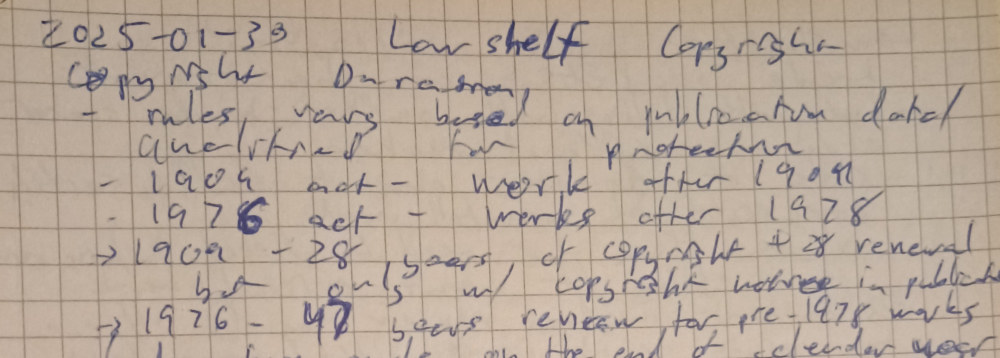
When engaging with academic content, I enjoy trying to recover the original structure used by the author into an outline. Sometimes it's very easy due to a well-written overview at the start, and sometimes I make up my own structure, but it is a fun way to gain a few more connections between topics.
I used to be very particular about how I format those outlines, but these days... I stick to only three:
- Dashes or arrows start every new sentence/point/line. (In the past, double arrows like "⇒" used to highlight summaries of previous points)
- Indentation between the dashes shows hierarchy between topics.
- Occasional lines in the margin link topics that the author jumped back and forth between.
Have a link pad
(i.e. "HALP")
This one I stole wholesale from Amin Hollon's urlref as I soon as I needed to cross-reference my notes at work with external links.
In my case, I didn't have the luxury of running my own server for redirecting notes to their destinations, nor the luxury of writing my own browser extension (due to enforced policies at work..), so instead I went for the simplest option: a bookmark folder in Chrome.
Now, if I want to talk about something found on the web in my notes, I do the following:
- Open the bookmarks sidebar.
- Check the current number of bookmarks in the "Linkpad" folder.
- Create a new bookmark, prefixing the title with "%(current number of links plus one)", e.g. "%10 urlref: website bookmarking for handwritten notes"
- Write down the "%(number)" in the notebook.
It is a bit painful, but it gets the job done—now, even for my older notes, I can quickly find the context for which they were written.
I suspect I will slowly improve the technique: I can introduce a different prefix for a personal/non-work linkpad, figure out a better way to encode numbers when I get into 3 and 4 digit ones, or maybe introduce a script for steps 1 through 3.
Never burn anything
("NBA"; hey look, a TLA!)
Notes are really cheap to keep around. A box can easily hold a few years' worth of notes, depending on how voluminous of a writer you are (and how much you like sketching; sketches easily double or triple the space needed).
With that in mind, I don't think it makes sense to throw away notes one dislikes. A good 5, 10, or 20 years in the future, you are going to have a whole new perspective to revisit those notes with. And chances are, you are going to want to revisit at least one previously-disliked note.
So, yes, I am a note hoarder. Please don't throw away information. 🥲
In closing
Notes are an excellent way of keeping track of what's happened. For me, notes are also a way of staying engaged in long, boring calls; instead of waiting for the call to end, I can enjoy expressing the major points presented in just a few pages.
I recall some highschool textbooks asserting how our grades would rise and memory improve as soon as we start spending time taking notes. And indeed, slowing down to write notes and engage with the material helps. But there are certainly things even notes won't help you remember, every brain needs slightly different techniques for engaging with things of passing interest, and note-taking, too, is no silver bullet.
Browse more articles?
← Simple CI/CD with bare git repositories Articles tagged toolbox (6/6) →|
← Programming agents in Rust Articles on this blog (51/51) →|